
The problem
A used car department lives or dies on what it buys. At a franchised dealership, that means a buyer working through auction and factory-direct listings every morning, opening each car, checking market value and history, guessing at reconditioning and deciding what to bid.
Most of that is research, not judgment. The same steps run on every car, and a good buyer spends hours on them before getting to the part only they can do.
The dealership asked us whether AI could take the research off the buyer's desk.
What we built
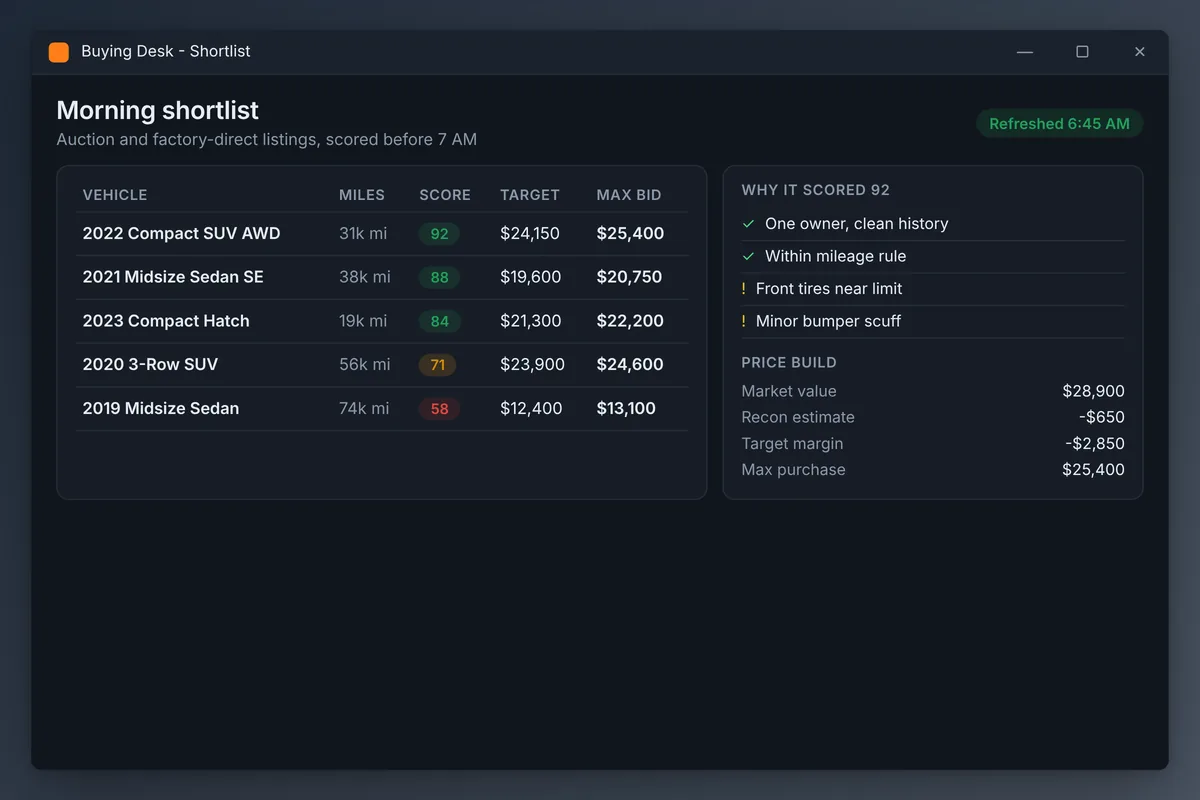
One dashboard that does the morning research before the buying team logs in.
- Ingestion from the auction and factory-direct platforms the dealer buys from. We designed for official APIs first, with a logged-in browser automation layer as the fallback where no API is available.
- Enrichment from the Cox Automotive suite: market value from MMR, the vAuto pricing range and the vehicle history report.
- An AI scoring engine on Claude that grades each car against the dealer's own criteria, flags condition issues from the listing and condition report, and estimates reconditioning cost.
- A pricing calculator that combines market value, the vAuto range, the reconditioning estimate and the dealer's target margin into two numbers: a target purchase price and a maximum purchase price.
- A Postgres database on Supabase that keeps every day's shortlist, scores and prices, so the history builds up.
- A scheduler that runs the whole pipeline each morning.
- A hosted web dashboard with the ranked shortlist, a drill-down on each car, a condition checklist, the price analysis and a deep link straight to the listing to place the bid.
How the scoring works
Each car moves through the same steps, in order.
- Pull the listing: year, make, model, trim, miles, location, condition report and photos.
- Look up market value and history.
- Have the AI read the condition report and listing against the dealer's rules: which models they want, mileage limits, history deal breakers and the condition issues they will or will not take on.
- Estimate reconditioning from the flagged issues.
- Work back from market value, reconditioning and target margin to the most the dealer should pay.
- Rank the day's cars by fit and margin, with the reason for each score written in plain language.
The buyer still makes every call. The difference is that they start the day with a ranked list and the math already done, instead of a blank search screen.
What we learned
The dealership looked at it and decided to stay with its existing tools for now. Its buyer pointed out that vAuto already automates a good part of the appraisal step for their volume, and that most of their purchases come through one factory-direct channel rather than open auction.
That was useful feedback, and it shaped how we scope this kind of work today.
What we would do again
Our take: sit with the person who places the bids before you design anything. The owner sees the opportunity. The buyer knows which steps already run themselves.
Map what the existing tools already do. A dealer on vAuto has a head start on pricing. The gap AI fills is reading condition reports, applying the dealer's own rules and writing down why a car made the list.
Make the AI explain its score. A ranked list without reasons is one more number to second-guess. A short reason next to each car is what a buyer can check in seconds.
If you are weighing a build like this, our guide to AI dashboards covers how we decide what belongs on the screen and what stays in the background.