
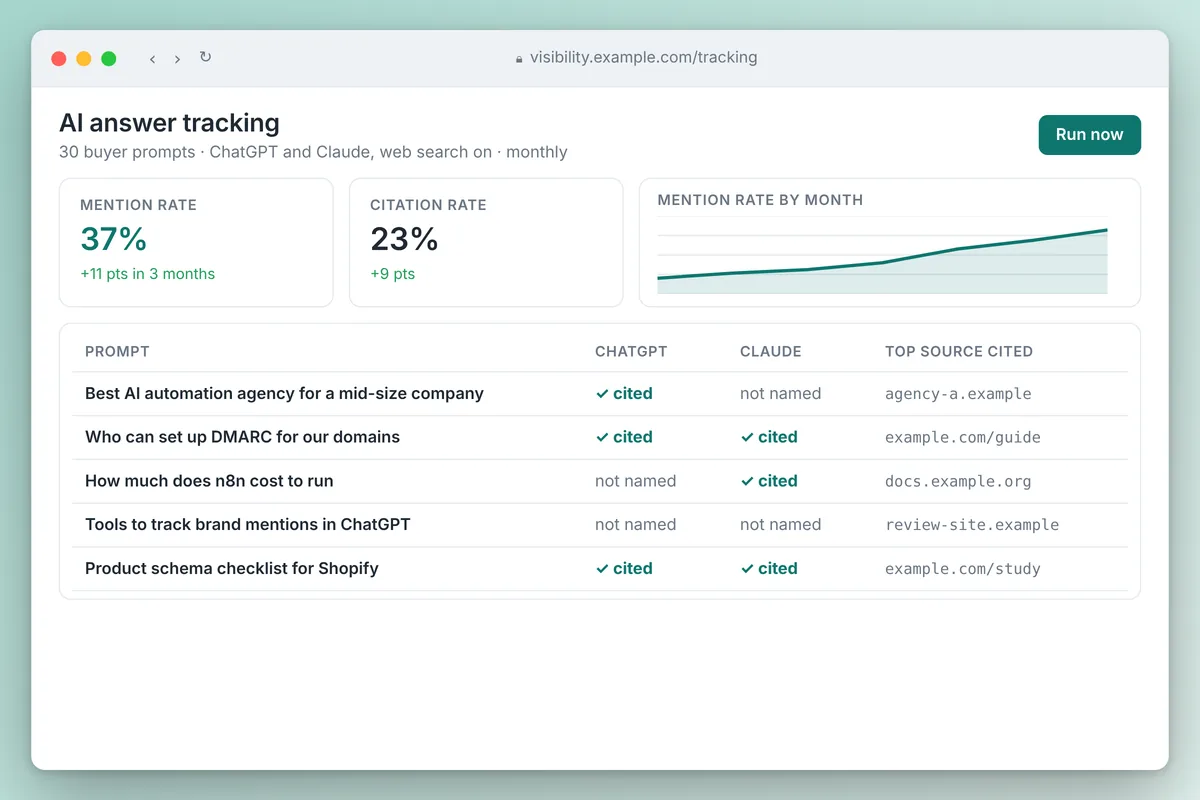
AEO services (answer engine optimization) are the work of getting your business named and cited when people ask ChatGPT, Claude, Perplexity or Google's AI Overviews a question. In practice that means testing what the AI tools say about your category today, fixing the pages and data they read, publishing content that answers buyer questions better than what they currently cite, and tracking mentions over time.
It overlaps heavily with SEO. Google's AI Overviews lean on pages that already rank, and the assistants that search the web pull from a search index before they answer. What AEO adds is a different target (being quoted in an answer rather than ranked in a list) and a different way of measuring.
We do this work on our own site every week, and for clients. Here is what it actually involves, without the jargon.
How AEO differs from SEO
SEO is measured in positions and clicks. AEO is measured in mentions and citations inside AI answers.
The work is mostly the same craft pointed at a slightly different reader. A search engine ranks a page. An answer engine reads a page, breaks it into passages, and lifts the passage that best answers the question. So the pages that get cited tend to answer the question directly in the first few lines, use headings that match how people actually ask, and give specific, checkable detail that the AI can quote with confidence.
Two differences change how we work. The first is that AI answers name brands, not just pages. When we ran the same buying questions through ChatGPT and Claude for our AI brand visibility study, the two tools agreed on about 7.5 of every 10 brands they named and picked the same top brand in 17 of 22 categories. If you are not in that short list, you do not exist for that buyer. The second is that AI tools read more than your website: review sites, directories, comparison articles, forum threads and press all feed what they say about you.
What AEO services include
A real AEO engagement has five parts. Be wary of anything that skips the first and last.
- Baseline testing. Run the questions your buyers ask through ChatGPT, Claude and Google with web search on, and record whether you are mentioned, who is mentioned instead and which sources are cited. This is the measurement everything else is judged against.
- Technical access. Make sure AI crawlers can reach and read your pages: robots.txt rules, server-rendered content rather than text that only appears after scripts run, clean structured data, a current sitemap and, optionally, an llms.txt file.
- Answer-first content. Rewrite key pages and publish new ones so each opens with a direct, quotable answer, uses question-style headings where they fit, and includes first-hand detail the AI tools cannot find elsewhere.
- Off-site presence. Get the business described accurately in the places AI tools read: industry directories, review platforms, comparison articles and press.
- Tracking. Rerun the same questions on a schedule and track mentions and citations next to search traffic.
What we learned doing AEO on our own site
Our own site is the test bed, so we can show what moved and what did not.
When we rebuilt shiptronix.com in October 2026, it had almost no search presence. We publish one new article and refresh one existing article every week, each opening with a direct answer and drawing on real work. Within a few weeks, Google impressions went from a handful a day to roughly 170 a day. Measured AI mentions were still at zero at that point, and that is normal. AI citation data tends to lag publishing by weeks, and the assistants lean on sources that already have some authority.
What moved first was long, specific, question-style searches. Pages that answered a narrow question precisely started ranking near the top for those phrasings well before they ranked for the short head term. That pattern matters for AEO because AI prompts look much more like those long questions than like two-word searches.
Original data has been the strongest lever. Our structured data study of 1,150 ecommerce product pages found that 93% have Product markup but only 29% include a GTIN. A number like that is quotable, and nobody else has it. We would put original research near the top of any AEO plan, ahead of another round of generic blog posts.
We got one thing wrong early. We assumed technical fixes would carry more weight than they did. Fixing structured data and adding llms.txt were worth doing, but neither moved anything on its own. Content and outside mentions did the heavy lifting.
How to measure AEO results
Measure the same set of prompts on a fixed schedule, and judge trends over months, not days.
We keep a fixed list of buyer questions and run it monthly through ChatGPT and Claude with web search on, logging whether we are mentioned or cited and which competitors and sources appear. Data providers such as DataForSEO now offer LLM mention tracking as well, which is useful for watching a larger set of prompts.
Track these side by side:
- Mention rate: the share of tracked prompts where your brand is named.
- Citation rate: the share where your site is linked as a source.
- Which competitors and sources appear in your place.
- Search Console impressions and clicks for the same topics, since Google's AI features draw on ranking pages.
Be patient with it. AI answers vary from run to run, so one result tells you little. A shift that holds across several monthly runs is real.
What AEO services cost and what to ask an agency
Pricing is all over the map, from a few hundred dollars for a one-time audit to several thousand dollars a month for ongoing content and outreach. The price matters less than whether the work includes measurement.
Questions we would ask any AEO agency before signing:
- Which prompts will you track, and can I see the baseline before we start?
- Which AI tools do you test, and with web search on or off?
- What content will you publish, and who supplies the first-hand detail?
- How do you get us mentioned off our own site?
- What do you report monthly, and what result would make you change course?
Be skeptical of guarantees. Nobody controls what an AI model says, and the answers change between runs. An agency that promises a specific position in ChatGPT is selling something it cannot deliver. For a broader checklist, our guide to hiring an AI automation agency covers the contract side.
If you want to see where you stand before spending anything, our free AI visibility check runs five buyer questions through ChatGPT and Claude and shows who gets named instead of you. For the strategy behind it, see our AI strategy consulting work.
Frequently asked questions
What is answer engine optimization?
Answer engine optimization (AEO) is the practice of getting your business mentioned and cited in answers from AI tools such as ChatGPT, Claude, Perplexity and Google's AI Overviews. It builds on SEO, but measures success by mentions and citations inside AI answers rather than by search rankings and clicks.
Is AEO different from GEO?
The terms are used almost interchangeably. Some people use GEO (generative engine optimization) for chat assistants like ChatGPT and AEO for Google's AI features and featured snippets, but the work is largely the same: answer-first content, technical access, off-site presence and tracking.
How long does AEO take to show results?
Expect months, not weeks. On our own site, search impressions rose within a few weeks of publishing, while measured AI mentions lagged further behind. AI tools favor sources that already have authority and outside mentions, and that takes time to build.
Does AEO replace SEO?
No. Google's AI Overviews draw heavily on pages that already rank, and AI assistants that search the web start from a search index. Good SEO is the foundation; AEO adds answer-first structure, off-site mentions and AI-specific tracking on top.
Can an AEO agency guarantee my brand appears in ChatGPT?
No one can guarantee that. AI answers change between runs and depend on what is published about you across the web. A good agency shows you a baseline, explains what it will change, and reports whether your mention rate moves over time.