
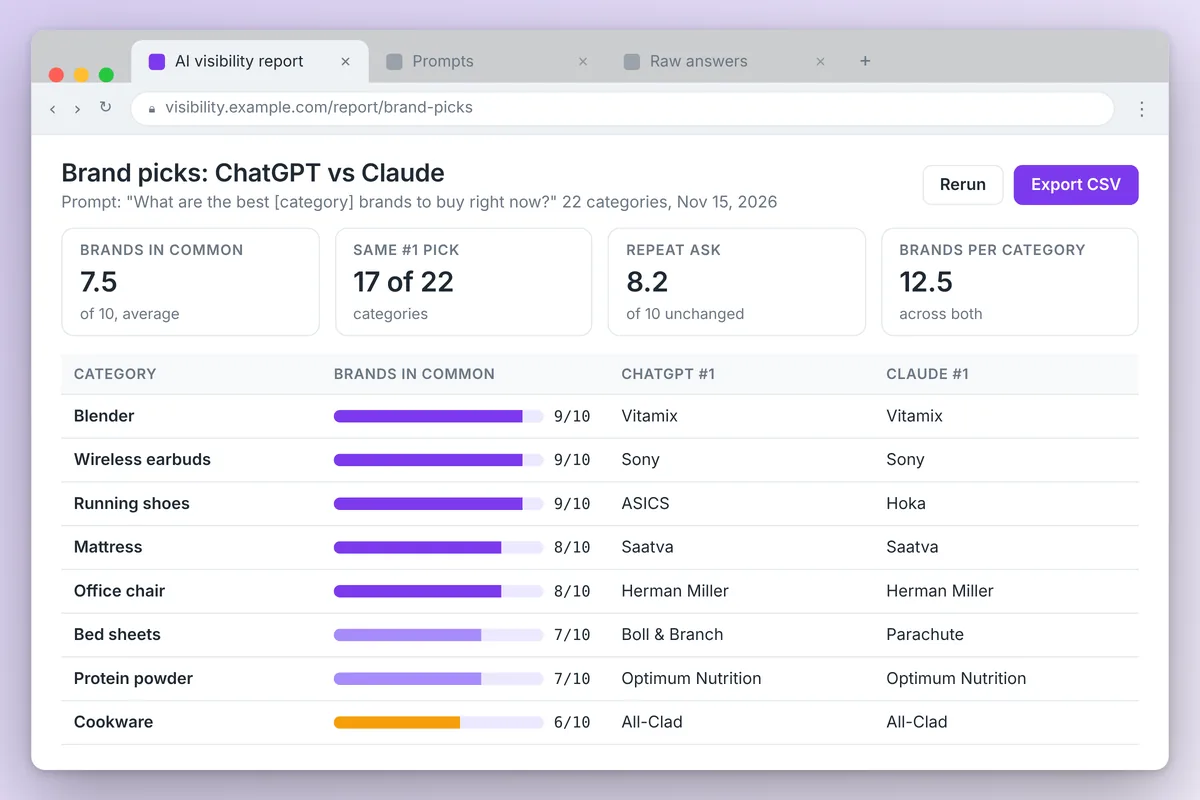
On November 15, 2026 we asked ChatGPT and Claude the same buying question in 22 ecommerce categories: what are the best brands to buy right now? On average the two assistants agreed on 7.5 of their 10 brands, and they named the same number one brand in 17 of the 22 categories. AI brand visibility comes down to a short list, and both assistants are mostly reading from it.
We expected more disagreement. These are different companies, different models, trained on different data mixes, and we assumed a challenger brand that missed one list would turn up on the other. Mostly it did not. Put both lists together and a category still only produced 12 or 13 names.
So if a shopper asks an assistant what to buy and you are not one of those dozen or so, you are out of the running before they ever see a search result. Trying the other assistant rarely helps.
We also re-asked six categories and ran three with web search turned on, because a single answer from a language model is a sample of one. Those results changed how we think about measuring this, and they are further down.
Key findings
- ChatGPT and Claude shared 7.5 of 10 brands on average. The closest categories shared 9 (blenders, carry-on luggage, running shoes, wireless earbuds). The furthest shared 5 (men's razors).
- They named the same top brand in 17 of 22 categories (77%).
- Across both assistants, each category produced 12.5 distinct brands on average. 60% of those brands were named by both assistants and 40% by only one.
- Asking ChatGPT the same question a second time gave 8.2 of the same 10 brands on average, across 6 categories. The two assistants agree with each other almost as much as ChatGPT agrees with itself.
- With web search turned on, the lists shifted toward brands featured in editorial review roundups and certification lists. The core names stayed.
How often do ChatGPT and Claude agree on brands?
Most of the time. Here is every category, sorted by how many of the ten brands the two assistants had in common, with each assistant's first pick.
| Category | Brands in common (of 10) | ChatGPT's #1 | Claude's #1 |
|---|---|---|---|
| Blender | 9 | Vitamix | Vitamix |
| Carry-on luggage | 9 | Briggs & Riley | Away |
| Running shoes | 9 | ASICS | Hoka |
| Wireless earbuds | 9 | Sony | Sony |
| Candles | 8 | Diptyque | Diptyque |
| Cooler | 8 | Yeti | Yeti |
| Insulated water bottle | 8 | Hydro Flask | Hydro Flask |
| Mattress | 8 | Saatva | Saatva |
| Multivitamin | 8 | Thorne | Thorne |
| Office chair | 8 | Herman Miller | Herman Miller |
| Rain jacket | 8 | Arc'teryx | Arc'teryx |
| Standing desk | 8 | Uplift | Uplift |
| Women's leggings | 8 | Lululemon | Lululemon |
| Bed sheets | 7 | Boll & Branch | Parachute |
| Portable solar panel | 7 | EcoFlow | Jackery |
| Protein powder | 7 | Optimum Nutrition | Optimum Nutrition |
| Travel backpack | 7 | Osprey | Osprey |
| Cookware | 6 | All-Clad | All-Clad |
| Dog food | 6 | Royal Canin | Royal Canin |
| Face moisturizer | 6 | CeraVe | CeraVe |
| Sunglasses | 6 | Maui Jim | Ray-Ban |
| Men's razor | 5 | Gillette | Gillette |
The categories where they disagree on the top spot are the ones where the market itself is split between two strong names, like Hoka and ASICS, or Away and Briggs & Riley. Nobody came out of nowhere at number one.
Our read: these models learned from the same reviews, forums and roundups. When the internet has made up its mind about a category, both assistants repeat it.
Is AI brand visibility random from one ask to the next?
Less than people think. We asked ChatGPT the identical question a second time in six categories (mattress, men's razor, bed sheets, cookware, sunglasses, protein powder). The second answer kept 8.2 of the 10 brands on average and kept the same top pick in 4 of the 6.
What moved was mostly the bottom half. The top five kept 4.2 of their 5 brands between runs, and in cookware, mattresses and sunglasses the same five came back in a different order. The swaps happened lower down.
That matters for how you measure this. If you check your brand once and see it in eighth place, run it again before you celebrate. If you check once and see yourself in second place, that is probably real.
Does web search change which brands get recommended?
It changes the edges, not the core. We reran three categories with web search on, so the assistant read current pages before answering.
For mattresses, the web answer kept 9 of the 10 brands from the answer without search. One brand dropped and Bear came in. For protein powder it kept 7 of 10, and the newcomers included a brand that sits on the NSF Certified for Sport list the assistant pulled up. For portable solar panels, the web answer leaned hard on one lab-tested roundup and added a rooftop-mount brand and a brand from a Forbes review to the list.
The sources are the part we found most useful. For mattresses the assistant searched Consumer Reports, Sleep Foundation, Tom's Guide and RTINGS. For protein powder it read roundups from Wired, AARP, Fortune and Men's Health, plus the NSF certification register. For solar panels it read almost entirely from one lab-tested review site, and the brand that site named best overall became the assistant's first pick.
So there are two ways onto the list. The slow way is being talked about enough that the model learned your name in training. The faster way is being in the handful of review pages and registries the assistant reads when it searches today.
Why your brand is or is not on the list
Looking down all 22 lists, a few things jumped out.
The number one spots go to brands that have owned their category for a long time: Vitamix, Gillette, Herman Miller, Royal Canin. If you are hoping to knock one of those off the top of an AI answer this quarter, we would not budget for it.
Direct-to-consumer brands do make it. Saatva, Away, Brooklinen, Boll & Branch, Parachute and Made In all showed up, alongside brands that are decades older. Being newer is not what keeps a brand off the list.
The bottom slots are where newer and smaller brands tend to show up, and they are the least stable. Claude added brands like Our Place, Misen and Nothing that ChatGPT left out. That is your opening if you are a challenger: you do not need to beat the category leader, you need to be one of the ten.
What should an ecommerce brand do about AI brand visibility?
If you only do one thing: find the five or six review pages that an assistant reads for your category, and work to get on them. Ask ChatGPT your buying question with search on, note every source it cites, and treat that list as your PR target list. That is the fastest lever we found.
After that:
- Check where you stand. Ask both assistants your category question at least twice each and record every brand named. That gives you a baseline you can rerun every quarter.
- Get into the registries that matter for your category. Certification lists, safety registers and lab-test databases get read by assistants and are hard for competitors to fake.
- Make your product pages easy to read. Clear product names, full specs and complete product schema with a GTIN help both Google and AI answers match your product to the question. Our product schema study found only 29% of brands include a GTIN.
- Earn reviews on the sites that test products. A single lab-tested best overall pick can carry a brand to the top of an AI answer, as it did in our solar panel test.
We do this work for brands as part of our ecommerce management service. If you want to know where you stand today, our free AI visibility check asks ChatGPT and Claude the questions your buyers ask and reports who they name instead of you.
Method
We sent each question through DataForSEO's LLM response API on November 15, 2026, to ChatGPT (model gpt-5.5) and Claude (model claude-sonnet-5-5). The prompt was identical for every category and both assistants: "What are the best [category] brands to buy right now? Answer with only a comma-separated list of up to 10 brand names, best first." Web search was off for the main comparison, so the answers reflect what each model knows on its own.
We normalized brand names before comparing (for example, Anker and Anker Soundcore count as one brand, as do Herman Miller and Herman Miller Embody). The repeat test used the same prompt and model in 6 categories. The web search test used ChatGPT with web search on in 3 categories: mattress and protein powder with the same model and prompt, and portable solar panels with gpt-5.4-mini and a longer, open-ended wording, so the solar result is the loosest of the three.
Limitations
API answers can differ from what a shopper sees in the ChatGPT or Claude app, which may add memory, location or shopping features. We asked one wording of the question per category; a shopper who asks for "budget" or "for side sleepers" will get a different list. Twenty-two categories is a sample, not the whole market, and we chose them to cover common direct-to-consumer categories. The web search test covered only three categories, so treat it as a direction, not a rate. We plan to rerun the same prompts each quarter and report what moves.
Frequently asked questions
How do I check if ChatGPT recommends my brand?
Ask it the question your customers ask, in their words, such as "what are the best [your category] brands right now?" Ask at least twice, with and without web search, and write down every brand named and every source cited. One ask is not enough, because the bottom of the list changes between runs.
Do ChatGPT and Claude recommend the same brands?
Mostly. In our test of 22 ecommerce categories they shared 7.5 of 10 brands on average and named the same top brand in 17 categories. They disagreed most where two strong brands split the market.
How long does it take to show up in AI recommendations?
It depends on the route. Getting into the model's built-in knowledge takes until the next training update, which you do not control. Getting onto the review pages and registries an assistant reads with web search can work within weeks once those pages are updated and indexed.
Does product schema help with AI brand visibility?
It helps assistants and Google match your product to a question, especially when it includes identifiers like a GTIN, price and availability. It will not put you on a list by itself. Coverage on trusted third-party pages still does most of the work.