
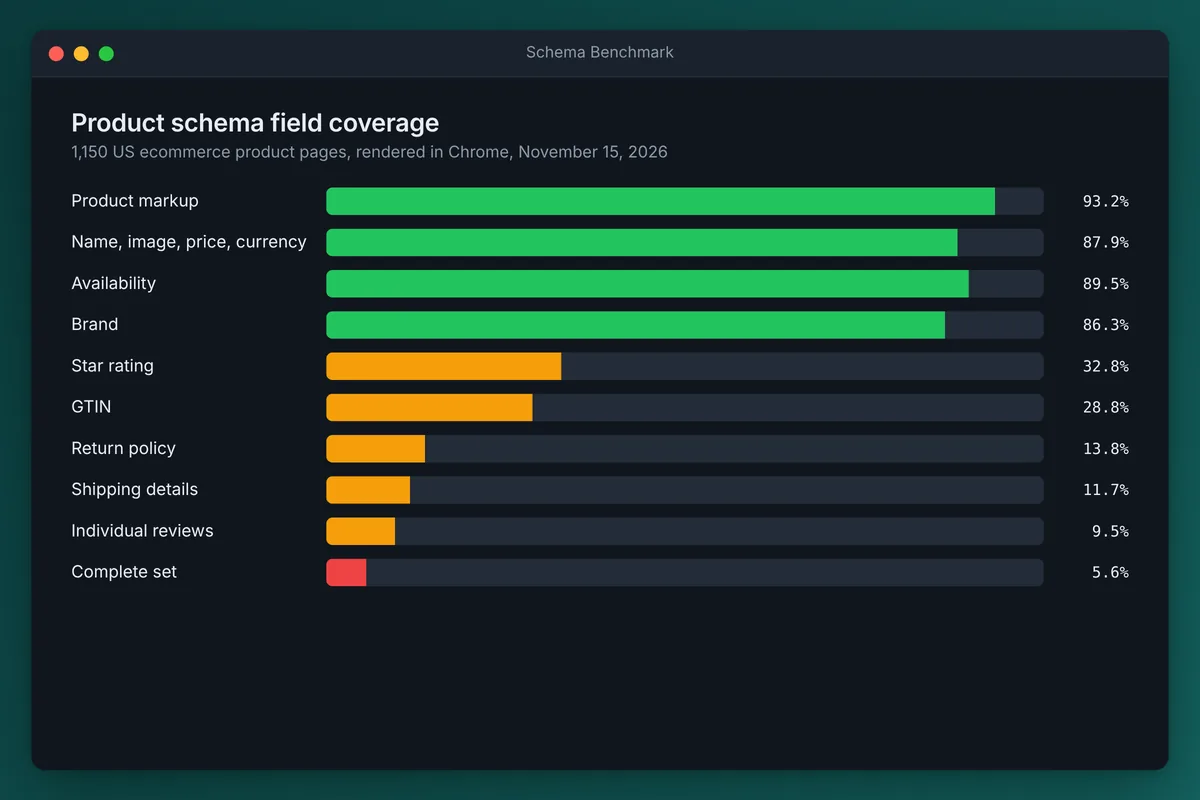
We checked the product schema on 1,150 US ecommerce product pages on November 15, 2026. 93% carry Product markup and 88% have the basics Google needs for a merchant listing: name, image, price and currency. But only 29% include a GTIN, 14% mark up a return policy, 12% mark up shipping, and 6% have the full set.
That is the story. Product schema itself is close to universal now, because Shopify themes and most commerce platforms add it for you. The fields that set a product apart, and that Google and AI shopping answers use to compare it, are the ones nobody fills in.
No brand is named here, and we do not publish the list.
Key findings
- 93.2% of product pages have Product markup. 5.1% have no structured data at all.
- 87.9% have name, image, price and currency, the core of Google's merchant listing markup.
- 28.8% include a GTIN (the barcode number). 42.2% include a GTIN or a manufacturer part number.
- 32.8% mark up an aggregate star rating. Only 9.5% mark up individual reviews.
- 13.8% mark up a return policy on the product page. 11.7% mark up shipping details.
- 5.6% have the complete set: core fields, availability, brand, an identifier, returns and shipping.
- Shopify stores lead on the basics: 89.0% have the core fields, against 81.5% on other platforms.
- Only 1.2% of product schema appears only after JavaScript runs. Almost every brand puts it in the page HTML, where AI crawlers can read it.
- On homepages, 80.2% have Organization markup, but only 4.4% put a store-wide return policy in it.
How many ecommerce brands use product schema?
Nearly all of them. Here is the field-by-field picture across the 1,150 product pages:
| Field | Share of product pages |
|---|---|
| Any structured data | 94.9% |
| Product markup | 93.2% |
| Price currency | 90.5% |
| Product image | 90.3% |
| Offer with a price | 90.1% |
| Availability (in stock or not) | 89.5% |
| Brand | 86.3% |
| SKU | 78.0% |
| Breadcrumbs | 48.3% |
| Star rating (aggregateRating) | 32.8% |
| GTIN | 28.8% |
| Product variants (ProductGroup or hasVariant) | 22.5% |
| Return policy | 13.8% |
| Shipping details | 11.7% |
| FAQ markup | 11.1% |
| Individual reviews | 9.5% |
Our read: the top half of that table comes free with the platform. The bottom half takes someone deciding to do it.
Which fields does Google actually require?
For a merchant listing, the hard requirements are small. Google's merchant listing documentation asks for a product name, an image and an offer with a price and a currency. Everything else is recommended.
88% of the pages we checked clear that bar. So the problem is not eligibility. It is that the listing has nothing else to show.
Returns and shipping are the clearest example. Google can show a return window and shipping cost next to a product. A shopper comparing two similar products sees that before clicking. Only about one product page in seven gives Google that information in markup.
Do you need a GTIN in your product schema?
If your products have barcodes, yes. A GTIN is the number that tells Google and AI tools that your product is the same item listed elsewhere, which is how they match reviews, prices and specs across sites.
Only 28.8% of the pages we checked include one. On Shopify stores it is 31.7%. On every other platform combined it is 11.9%.
Our take: this is the cheapest fix on the list. The number is usually already in your product catalog or your Amazon listing.
One caution. Do not invent a GTIN or reuse one across variants. A wrong identifier is worse than a missing one, because it points the product at someone else's listing.
Are ratings and reviews marked up?
Ratings more than reviews. 32.8% of pages mark up an aggregate star rating, but only 9.5% mark up individual reviews. 271 pages have the stars without a single review in markup.
The likely cause is the review app. Many output the average and the count, and leave the review text in the page as plain HTML. AI tools that summarize what buyers say about a product read that text, so give them the reviews in markup where your app allows it.
Should the return policy go on every product page?
No. Google now accepts a store-wide return policy in your Organization markup. Its return policy documentation says a standard policy can sit under Organization using hasMerchantReturnPolicy, and recommends one page on your site rather than every page. You only add it to a product when that product's policy is different.
Almost nobody has done it. 4.4% of the homepages we checked had a return policy in their Organization markup. Combined with product pages, 14.3% of brands mark up a return policy anywhere we looked.
If you only do one thing from this article, do this one. It is a single block of markup, written once, and it covers your whole catalog.
Does product schema need to load without JavaScript?
It should, and almost everyone gets this right. Google renders JavaScript before it reads a page. Most AI crawlers do not. Vercel and MERJ's crawler study found that none of the major AI crawlers they measured, including OpenAI's and Anthropic's, run JavaScript. Google's own Merchant Center guidance also recommends putting Product markup in the initial HTML.
We loaded each product page twice, once as plain HTML and once in a full browser, and compared them. Of the 1,016 pages where both loads worked and markup was present, only 12 (1.2%) had product schema that appeared only after JavaScript ran.
So if your schema is thin, it is thin for every crawler.
Does your platform matter?
On the basics, yes. Shopify stores were 982 of the 1,150 product pages:
| Field | Shopify (982) | Other platforms (168) |
|---|---|---|
| Product markup | 92.7% | 96.4% |
| Name, image, price and currency | 89.0% | 81.5% |
| Availability | 91.2% | 79.2% |
| Brand | 89.9% | 64.9% |
| GTIN | 31.7% | 11.9% |
| Return policy | 14.4% | 10.7% |
| Shipping details | 11.2% | 14.9% |
Shopify themes ship with offer, availability and brand markup built in. Custom builds depend on whoever wrote the templates, so they are more likely to have a Product block with gaps in it.
The platform stops helping at returns and shipping. Those take a policy decision, not a theme setting.
What do homepages carry?
Organization markup is common, and incomplete. Across the 1,150 homepages:
- 80.2% have Organization or a store type
- 69.9% include a logo
- 60.2% list social profiles with sameAs
- 29.5% include a phone number, email or contact point
- 4.4% include a return policy
59.4% still carry SearchAction markup for the sitelinks search box. Google retired that search box on November 21, 2024. Google says there is no need to remove it, but it shows how rarely anyone revisits schema after launch.
What should an ecommerce brand do with this?
In this order:
- Add a store-wide return policy to your Organization markup.
- Fill in GTINs for every product that has a barcode.
- Add shipping details, at least for your standard domestic rate.
- Mark up individual reviews if your review app supports it.
- Check that it all appears in the page source, not only after the page loads.
Test each change in Google's Rich Results Test before you move on. Then check Search Console's merchant listings report a few weeks later.
We run this exact check as part of our ecommerce management work, and you can send us a page for a free structured data check. We also checked the email security of the same brands: half of them are exposed on both fronts.
Method
- Run date: November 15, 2026.
- Sample: 2,288 US ecommerce and direct-to-consumer brand domains, mostly consumer products, retail, food and health companies from the Inc. 5000 lists for 2018 to 2024, plus well-known DTC brands and large US retailers. Marketplaces and non-US brands were excluded.
- Product pages: one per brand, taken from the store's public product feed (Shopify), a product link on the homepage or the product sitemap. Gift cards and add-ons were skipped. A page counted only if its own markup or the store's product feed confirmed it was a single product. 1,150 brands qualified. The rest blocked automated access, had no findable product page or did not resolve.
- 85% of qualifying stores run on Shopify, so the results describe growth-stage DTC brands more than large retailers.
- Product pages were read after JavaScript ran, in headless Chrome, and again as plain HTML for comparison. Homepages were read as plain HTML.
- Extraction: JSON-LD, microdata and RDFa.
- Core merchant fields: Product with a name and image, and an Offer with a price and currency, following Google's merchant listing documentation.
- Read-only: public pages only, no forms submitted, no company contacted.
Limitations
- The sample is not random. It comes from lists of fast-growing and notable brands, and sites that block automated browsers are missing. Those skew large.
- One product page per brand. Other pages on the same site may be marked up differently.
- Return policies placed only on a dedicated returns page were not checked, so the return policy figure is a floor.
- Presence only. We checked whether a field exists, not whether its value is correct.
- This is a snapshot of one day. Themes and apps change.
Frequently asked questions
What percentage of ecommerce sites use product schema?
In our November 2026 check of 1,150 US ecommerce product pages, 93.2% had Product markup and 87.9% had the core fields Google's merchant listings require: name, image, price and currency. Far fewer had the recommended fields: 28.8% included a GTIN, 13.8% a return policy and 11.7% shipping details.
What is the minimum product schema Google needs?
Google's merchant listing markup requires a Product with a name and an image, and an Offer with a price and a currency. Availability, brand, GTIN, ratings, reviews, return policy and shipping details are recommended and give Google more to show.
Does Shopify add product schema automatically?
Most Shopify themes include Product markup with name, image, price, currency and availability. In our check, 92.7% of Shopify product pages had Product markup. Fields like GTIN, return policy and shipping usually need a theme edit, an app or Organization markup on top of the default.
Can AI tools like ChatGPT read my product schema?
Only if it is in the page HTML. Most AI crawlers do not run JavaScript, so markup added only by a script after the page loads can be invisible to them. In our check, 1.2% of product pages had that problem.
Can I see the list of brands you checked?
No. We publish aggregate figures only and do not name brands.