
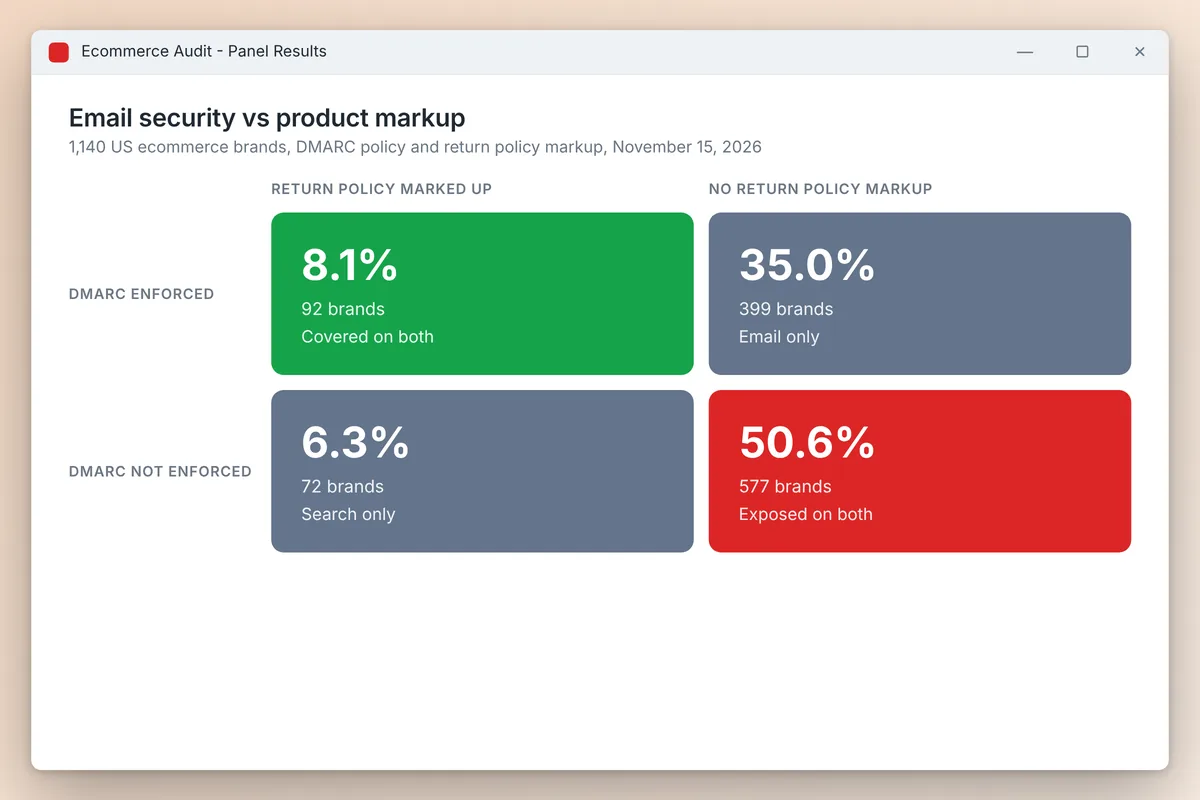
We audited 1,140 US ecommerce brands on November 15, 2026, checking two things on each one: whether its email domain is protected from spoofing, and whether its product pages tell Google and AI tools what they need to know. 50.6% fail on both. They do not enforce DMARC, and they do not mark up a return policy anywhere. Only 8.1% get both right.
Those are two different teams, two different tools and two different vendors in most companies. The data says the gaps travel together anyway.
No brand is named here, and we do not publish the list.
Key findings
- 56.9% of brands do not enforce DMARC, so anyone can send email that looks like it came from them.
- 85.6% have no return policy in their structured data, on the product page or the homepage.
- 50.6% have both problems at once.
- 8.1% enforce DMARC and mark up a return policy. 2.6% enforce DMARC and have the complete product markup set.
- Brands that enforce DMARC are more likely to mark up returns: 18.7% against 11.1%.
- Shopify brands are more exposed: 52.4% fail on both, against 40.2% on other platforms.
- Of brands sending through Klaviyo, 47.2% fail on both.
What we checked
Two audits, run on the same day against the same brands.
Email: we read each domain's public DNS records for SPF, DKIM and DMARC. A brand counts as protected when its DMARC policy is quarantine or reject. At p=none, or with no record, mailbox providers are told to deliver mail that fails authentication, so a fake order or refund email can land in a customer's inbox.
Search: we loaded one product page per brand in a full browser and read its structured data, the markup Google and AI shopping tools use to understand a product. A brand counts as covered on returns when it marks up a return policy on the product page or in its homepage Organization markup.
The full results of each audit are in their own articles: DMARC adoption in ecommerce and product schema in ecommerce.
How many brands are exposed on both?
About half. Here is the full split across the 1,140 brands:
| Return policy marked up | No return policy markup | |
|---|---|---|
| DMARC enforced | 92 (8.1%) | 399 (35.0%) |
| DMARC not enforced | 72 (6.3%) | 577 (50.6%) |
The bottom right cell is the story. 577 brands can be spoofed by email, and they are not telling Google or AI tools their return terms, which is one of the first things a shopper compares.
Our read: neither fix is hard. Both get skipped because no one owns them. Email authentication sits with whoever set up Google Workspace or Microsoft 365. Structured data sits with whoever picked the theme. Neither person is asked to come back to it.
Do the two gaps really travel together?
Partly. Brands that enforce DMARC are more careful with their markup in some places and no different in others:
| Product page field | DMARC enforced (491) | Not enforced (649) |
|---|---|---|
| Return policy (page or homepage) | 18.7% | 11.1% |
| Star rating | 39.1% | 27.9% |
| Complete product markup set | 6.1% | 5.1% |
| GTIN | 28.7% | 28.4% |
| Organization markup on homepage | 79.6% | 80.9% |
Returns and ratings move with email security. GTINs and basic Organization markup do not, because the platform supplies those regardless.
We would not claim one causes the other. The simpler explanation is that some brands have someone who revisits setup work after launch, and that person tends to fix both.
Is it worse on Shopify?
On this measure, yes. 976 of the brands run on Shopify, and 52.4% of them fail on both counts. On other platforms it is 40.2%.
That is not because Shopify is weaker. Shopify gives every store a working product markup baseline and makes it easy to send email through apps. What it does not do is set your DMARC policy or write your return policy into markup. Those are left to the brand, and growth-stage brands leave them.
Why does this matter for an ecommerce brand?
Both gaps hit the same moment: a customer deciding whether to trust you.
- On email, an unenforced DMARC policy lets a scammer send a fake shipping or refund email from your exact domain. Your customers cannot tell the difference, and you hear about it from them.
- On search, a product without return and shipping markup shows less in Google's shopping results and gives AI shopping answers less to quote. A competitor that marks it up looks like the safer buy.
Google's sender guidelines only require bulk senders to publish DMARC, and p=none is accepted. Google's return policy documentation lets a brand publish one store-wide policy under its Organization markup. Neither requirement forces the step that protects you. That is why most brands stop short.
What should an ecommerce brand fix first?
Both fixes fit in a week. In this order:
- Find every service that sends email as your domain: your store, Klaviyo or your email platform, your help desk and your inbox. Make sure each one passes SPF or DKIM.
- Move DMARC to p=quarantine, then to p=reject once nothing legitimate is failing.
- Add a store-wide return policy to your homepage Organization markup.
- Add shipping details and GTINs to your product markup.
- Recheck both in a month. Settings drift when apps and themes change.
We did step 2 on our own domain the day we ran this audit. Our record was still at p=none, which is exactly the pattern the data shows.
We fix both as part of our ecommerce management and email and domain security work. You can also start with a free email deliverability check or a free structured data check.
Method
- Run date: November 15, 2026.
- Sample: 2,288 US ecommerce and direct-to-consumer brand domains, mostly consumer products, retail, food and health companies from the Inc. 5000 lists for 2018 to 2024, plus well-known DTC brands and large US retailers. Marketplaces and non-US brands were excluded.
- Included: brands with a working online store, where we confirmed a single product page from its markup or the store's product feed (1,150), and that receive email, with an MX record (1,140).
- Email: public DNS over HTTPS through Cloudflare's resolver, with one retry per failed lookup. DMARC counts as enforced at p=quarantine or p=reject with a valid record. Klaviyo use was inferred from SPF and Klaviyo's documented DKIM selectors.
- Search: product pages read in headless Chrome after JavaScript ran, homepages as plain HTML. JSON-LD, microdata and RDFa. A return policy counts if MerchantReturnPolicy appears on the product page or in homepage Organization markup.
- 85% of the brands run on Shopify, so the results describe growth-stage DTC brands more than large retailers.
- Read-only: public DNS and public pages only. No email was sent, no form submitted and no company contacted.
Limitations
- The sample is not random. It comes from lists of fast-growing and notable brands, and sites that block automated browsers are missing.
- Return policies published only on a dedicated returns page were not checked, so the coverage figure is a floor.
- One product page per brand. Other pages on the same site may differ.
- This is a snapshot of one day. DNS records, themes and apps change.
Frequently asked questions
What should an ecommerce website audit include?
At minimum: email authentication (SPF, DKIM and an enforced DMARC policy), product structured data (price, availability, brand, GTIN, return policy and shipping), page speed and whether AI crawlers can read your pages. In our audit of 1,140 brands, the email and structured data checks alone found half of brands exposed on both.
What percentage of ecommerce brands enforce DMARC?
In our November 2026 audit of 1,140 US ecommerce brands with working stores, 43.1% enforced DMARC with p=quarantine or p=reject. 49.7% were at p=none, which monitors but blocks nothing, and 6.6% had no DMARC record.
How many ecommerce brands mark up their return policy?
14.4% of the brands we checked marked up a return policy anywhere we looked, on the product page or in homepage Organization markup. Google accepts one store-wide policy under Organization, so this is usually a single block of markup.
Are Shopify stores less secure?
Not inherently. Shopify stores in our audit had strong default product markup, but 52.4% of them did not enforce DMARC and had no return policy markup, against 40.2% on other platforms. Shopify leaves DMARC and return policy markup to the brand, and most growth-stage brands have not set them.
Can I see the list of brands you checked?
No. We publish aggregate figures only and do not name brands.