
Amazon after-Christmas sales run from December 26 into the first weeks of January, and for sellers they are a different business from November. Shoppers are spending gift cards and returning gifts at the same time, fees are still at holiday rates until January 14, and storage drops back to the off-peak rate on January 1. The sellers who do well plan this window before Christmas, not on December 26.
We run Amazon for our own brands and help other sellers with theirs. Most of the money lost in late December is lost quietly: ads left on holiday settings, a deal that clears stock you were going to sell at full price anyway, and returns nobody budgeted for.
Here is how we plan the window.
What changes on Amazon after Christmas
Three things shift at once, and they pull in different directions.
Demand changes shape. The gift buyer is gone. In their place you get people spending gift cards and credit, people buying the thing they actually wanted, and people replacing what they got. Categories tied to New Year resolutions (fitness, kitchen, organization) pick up. Pure gift items fall off a cliff.
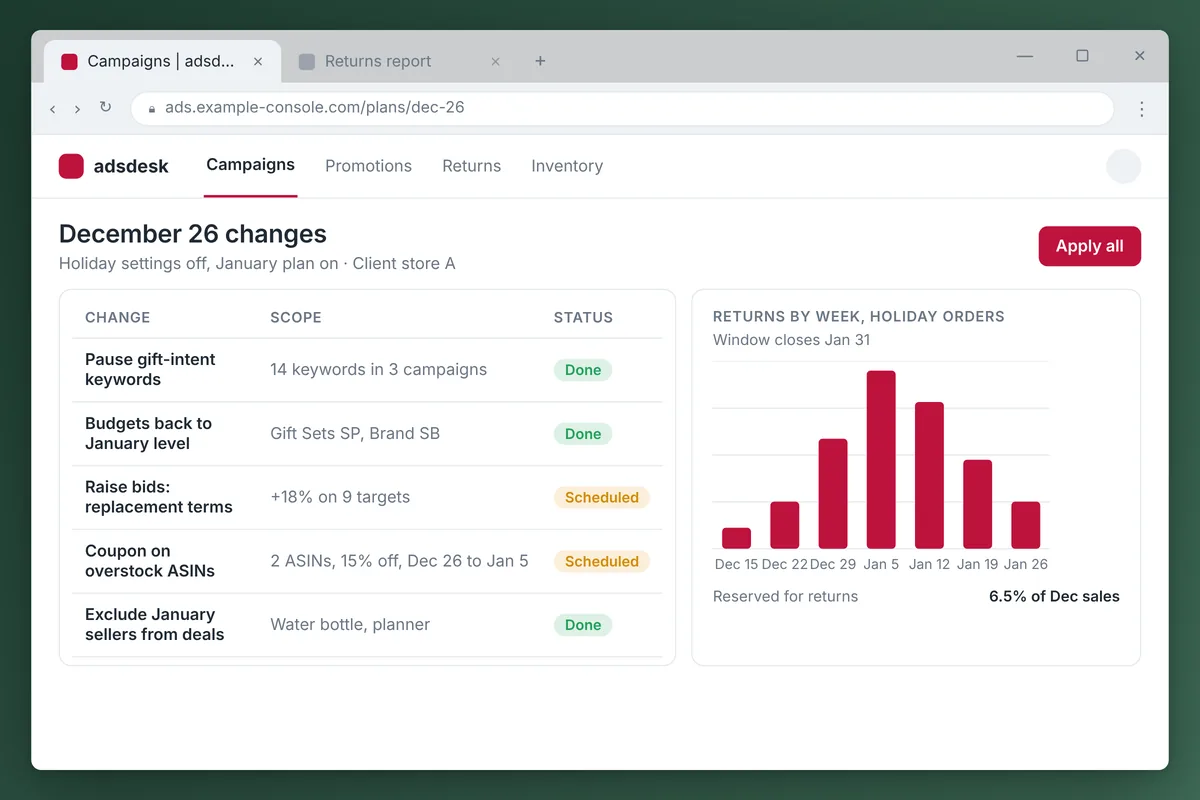
Returns come in. Amazon's extended holiday return window lets customers return most items bought between November 1 and December 31 until January 31. For 2026, Amazon told sellers in an October Seller News post that the window covers purchases from November 1, 2026 through December 31, 2026, returnable through January 31, 2027, and that this policy will apply every year. Apple products have an earlier cutoff of January 15.
Fees are mid-transition. Amazon's holiday peak fulfillment fees run from October 15, 2026 through January 14, 2027. Monthly storage is on a different calendar: the higher Q4 rate covers October through December and drops back on January 1. Check the current numbers on Amazon's FBA fee pages before you plan around them, because they change every year. The shape is what matters here. Standard-size storage roughly triples in Q4, so every unit still sitting in a fulfillment center in December is costing you about three times what it will in January.
Should you run a deal after Christmas?
Run a deal when you have inventory you want gone before January's storage bill and the aged-inventory clock, and the product still sells without the gift angle. Skip it when the product sells fine at full price in January.
That second case is where sellers burn margin. A deal on December 26 feels like the thing to do because everyone else is running one. But if your product is a January product (a water bottle, a planner, a resistance band set), the buyer is coming anyway. Discounting it just moves full-price sales into a lower price.
The question we ask on each ASIN is simple: if we did nothing, how many weeks of cover would we have on February 1? If the answer is more than three or four months for a product that is not seasonal to spring, it is a candidate. If it is six weeks, leave it alone.
Lightning Deals and Prime-exclusive discounts need to be scheduled in advance, and the slots around the holidays fill up. Coupons are faster to set up and easier to turn off. For the after-Christmas window we usually lean on coupons for that reason: if a product starts moving on its own on December 27, we can pull the coupon the same day.
How to change your Amazon ads for the after-Christmas window
Do not leave your holiday campaign settings running into January. That is the single most common mistake we see in accounts we audit in the new year.
Before Christmas, most sellers raise budgets, push bids on gift terms and add placement boosts on top of search. All of that was set for a buyer who is no longer there. On December 26 we go through it in this order.
- Pull your last year's search term report for December 26 to January 10 and see which terms actually converted. That is a better guide than this year's November data.
- Cut or pause gift-intent keywords ("gift for dad", "stocking stuffer", "christmas gift for her"). They keep spending after the 25th and convert poorly.
- Bring budgets back to a level your January demand supports, then raise them on the specific campaigns that are still converting.
- Add or raise bids on replacement and upgrade terms, and on resolution terms if your category has them.
- Check your TACoS weekly, not daily, through January. Holiday spend and holiday returns make daily numbers noisy.
We explain why we watch total ad cost of sale rather than ACoS in our guide to Amazon TACoS. In January that matters even more, because returns hit your total sales but your ad console does not show them.
Plan for returns before they arrive
A product that sold well in December will see returns through all of January. Budget for them as a cost of the season, not as a surprise.
The mistake we made the first year was reading December's sales as final. They were not. The units sold, and then a slice of them came back over the next five weeks, some in a condition we could not resell. The fix was simple: we now hold back a returns estimate per ASIN, based on that product's normal return rate plus a holiday bump, before we call the season a success.
Three things help in practice. Watch your FBA customer returns report weekly in January, not at the end of the month. Look at the return reasons for patterns: "item defective" and "not as described" point to a listing or quality problem you can fix before spring, while "no longer needed" is just gift season. And check how Amazon is grading returned units, because sellable returns go back into stock and change your inventory position for February.
The January inventory call
January is when you decide what to send in for spring, and when you clear what you should not have sent in for Q4.
Storage drops back to the off-peak rate on January 1, which takes some pressure off. But the aged-inventory surcharge keeps running, and units you sent in for Black Friday that did not sell are now months closer to that threshold. We cover the mechanics in our guide to Amazon FBA inventory management.
Our order of operations for the first two weeks of January:
- Look at weeks of cover per ASIN using January sell-through, not December's.
- For anything with far too much cover, compare the cost of a removal order, a liquidation, or a deeper discount against what it will cost to hold.
- Hold off on big inbound shipments until the peak fulfillment fees end on January 14 if the timing works for your stock levels.
- Fix the listings that drew "not as described" returns before you send more units in.
What we would do the week before Christmas
If you only do one thing: write down your December 26 changes now, while you still remember what you set up for the holidays.
That means a short list per account. Which campaigns get paused, which budgets come back down and to what, which coupons start on the 26th and which ASINs are excluded because they sell fine in January. On December 26 nobody wants to rebuild that from memory, and most teams are out. With the list written, it takes about an hour.
If you want a second set of eyes on the account before then, our Amazon advertising management work starts with exactly this kind of audit, and the free Amazon listing score is a quick way to see whether your top ASINs are ready for January traffic.
Frequently asked questions
When do Amazon after-Christmas sales start?
They start on December 26 and run into early January. Amazon does not run one official after-Christmas event the way it does Prime Day, so most of what shoppers see is individual sellers' deals, coupons and price drops, plus Amazon's own promotions in some categories.
How long can customers return Amazon holiday purchases?
Most items bought on Amazon.com between November 1 and December 31, 2026 can be returned until January 31, 2027. Apple products have an earlier deadline of January 15. Amazon has said it will apply this window every year, so sellers should plan for it as a standing policy.
When do Amazon's holiday peak fees end?
For the 2026 season, Amazon's holiday peak fulfillment fees run from October 15, 2026 through January 14, 2027. Q4 storage rates run October through December and drop back on January 1. Confirm the current figures on Amazon's fee pages, since they change each year.
Should I lower my Amazon ad budget after Christmas?
Usually, yes, at least at first. Cut gift-intent keywords and bring budgets back to January demand on December 26, then raise spend on the campaigns that are still converting. Leaving holiday settings running into January is one of the most common ways sellers waste ad spend.
Is it worth running a Lightning Deal after Christmas?
It is worth it for products with too much inventory going into January that still sell without the gift angle. It is not worth it for products that sell well at full price in January anyway, because the deal just discounts sales you would have made.