
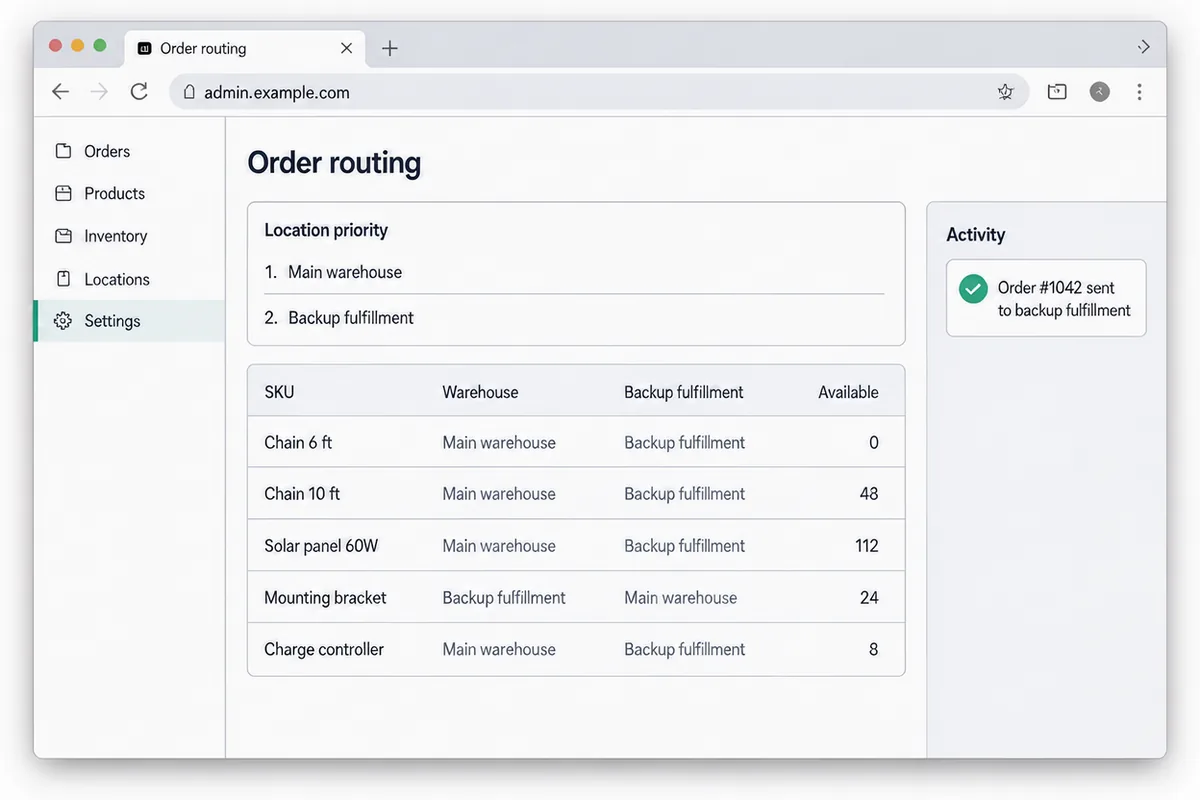
Amazon MCF (Multi-Channel Fulfillment) is Amazon shipping your non-Amazon orders, say from your Shopify store, out of the inventory you already have sitting in FBA. Plain box, per-unit fee. We run it as a backup behind our own warehouse, so a SKU that would show sold out on the website can still sell.
Some context on why we bothered. We run a few consumer brands that sell on Amazon and on their own Shopify sites, and a 3PL ships the Shopify orders. A couple of times a quarter something runs out at the 3PL while Amazon is holding hundreds of them. The website just said sold out and we ate it.
This is what we set up in October and November 2026, what broke and what it costs.
What MCF is (and isn't)
It's fulfillment only. The customer still buys on your site and pays you. Amazon gets a fulfillment request, ships from its network and sends tracking back to Shopify.
You don't have to sell on Amazon to use it, but in practice almost everyone using it already has FBA stock. Amazon quotes 3-day standard and 2-day expedited on its MCF page. No referral fee on these orders. You pay a fulfillment fee based on size, weight, units in the order and ship speed.
Packaging is unbranded by default and doesn't cost extra, per Amazon's own Walmart fulfillment post. Also know that Amazon charges a per-unit holiday peak fee on MCF from October 15 to January 14 (it's in the fees policy). We set this up right in the middle of that window.
Backup, not the main warehouse
Back in June we looked at sending all our Shopify orders through Amazon and said no. My partner ran a test order in Seller Central. One unit came back at $11.01 standard and $13.92 expedited. Five of the same item: $27.17 and $30.58. Our 3PL is a lot cheaper than that on multi-unit orders, so that was the end of it.
A stockout is a different question though. If the 3PL has zero and Amazon has plenty you aren't comparing MCF to the 3PL anymore. You're comparing MCF to no sale. A few extra dollars of shipping on one order is fine.
So the rule: 3PL ships everything it can, Amazon only gets what the 3PL can't fill, and if both are out the site goes out of stock.
The Shopify setup
We used Amazon's own app. Shopify lists it as the Amazon Multi-Channel Fulfillment (MCF) and Buy with Prime app. We turned on MCF and left Buy with Prime off. Didn't want Prime badges or a second checkout on the store.
Once it's installed Amazon shows up in Shopify as another inventory location, and the app keeps that count in sync with FBA. The 3PL stays its own location. Then:
- Connect the seller account, MCF only.
- Match Shopify variants to Amazon SKUs. Same SKU on both sides matches automatically. Ours mostly weren't the same, and one store still has about 50 to match by hand.
- Turn on only the SKUs you want Amazon shipping. We did two.
- In order routing, put the 3PL above Amazon.
- Shopify Flow: when an order lands on the Amazon location, submit it to Amazon and email us the order number, SKUs and ship-to city/state.
Amazon's user guide for the app has basically the same Flow (order ready to fulfill, location is Amazon, submit). The email was ours. I wanted eyes on every Amazon order until we trusted it.
First brand went live October 28 with two chain SKUs that were out at the 3PL. Second brand on November 15 with one solar panel. That panel was sold out on the site but had 96 units inbound to FBA and 516 more at AWD (Amazon's bulk storage). As soon as FBA checks those in the listing comes back by itself.
First clean order was November 18. One chain to Oregon, email hit both our inboxes, tracking showed up in Shopify. My partner asked right away if the site still goes out of stock when Amazon is out too. Yes. Shopify won't sell a unit unless one of the two locations has it.
What bit us
The 3PL, first. Their ShipStation pulls orders straight out of Shopify and it was grabbing the ones assigned to Amazon too. On November 6 they emailed that they were out of stock on an order Amazon was already handling. Nothing shipped twice. But "please ignore these orders" isn't a process. The fix is limiting their import to their own location so Amazon orders never get to them.
Then Walmart. Our Walmart orders come into Shopify through a connector, which means a Walmart order for one of these SKUs can route to Amazon like anything else. Walmart won't let an order show up on an Amazon-branded truck. You can block Amazon Logistics in MCF so it goes UPS, USPS or FedEx instead. Amazon's fees policy adds 5% when you do that, whether you block it account-wide or order by order.
That one came up fast. November 5, a Walmart order for a pilot SKU landed on the Amazon location. The Flow is set to hold Walmart orders back from MCF and send an "action needed" email, which it did. I keyed it into Seller Central by hand and Amazon shipped it the next evening.
Better news than we expected on the 5%. In that same Walmart post Amazon says it's waiving the surcharge on Walmart Marketplace orders until January 14, 2027. Confirm the date before you count on it.
What it costs
I'm not putting a rate card here. Amazon changes MCF fees every year and the tiers move. Do what we did: build a test order in Seller Central for your actual product, one unit and then five, and hold it up against what your 3PL charges for pick, pack and postage on the same order.
When you compare, remember:
- the holiday peak fee (Oct 15 to Jan 14)
- 5% if you block Amazon Logistics
- FBA storage on whatever you keep there for MCF
- discounts, if you get them
Amazon has MCF Preferred Pricing for eligible sellers, up to 15% off MCF fees plus up to a $1 FBA credit per unit. We have three seller accounts. In October only one of them showed the offer. Check Your Incentives in Seller Central.
Is it worth setting up?
If you keep real inventory at FBA and your warehouse stocks out every so often, yes, as a backup. The app is free to install and the routing doesn't take long. SKU matching and testing is where the time goes.
Thinking about moving everything to Amazon? Run the five-unit quote before anything else. That number killed it for us.
There's one more angle we're working through right now. We have slow sellers parked at AWD that are about to start paying long-term storage. AWD feeds FBA, and once they're in FBA the website can sell them through MCF. That might beat paying to haul them back to the 3PL. Our FBA inventory management guide covers the inventory side.
We set this kind of thing up for brands as part of our e-commerce management service, same as posting Shopify orders to QuickBooks. Start with one or two SKUs. Watch ten orders go through. Then turn on the rest.
Frequently asked questions
What is Amazon MCF and how does it work with Shopify?
Amazon MCF (Multi-Channel Fulfillment) ships orders from non-Amazon channels using your FBA inventory. On Shopify, Amazon's app adds Amazon as an inventory location, syncs its stock from FBA and sends orders assigned to that location to Amazon, which ships them and returns tracking.
Can I use Amazon MCF only when my own warehouse is out of stock?
Yes. Rank your warehouse above the Amazon location in Shopify's order routing, so Shopify only assigns an order to Amazon when the warehouse cannot fill it. Then use Shopify Flow to submit only those orders to MCF. Test with a few real orders, including carts that mix in-stock and out-of-stock items.
Is Amazon MCF cheaper than a 3PL?
Sometimes for a single small unit, often not for multi-unit orders. Our June 2026 test quote went from $11.01 for one unit to $27.17 for five on standard shipping. Get a test quote in Seller Central for your own products and compare it to your 3PL's all-in cost before deciding.
Can I use Amazon MCF for Walmart orders?
Yes, if the order ships in unbranded packaging and not on Amazon Logistics. Blocking Amazon Logistics normally adds a 5% surcharge, which Amazon says it is waiving for Walmart Marketplace orders until January 14, 2027. Make sure Walmart orders that reach Shopify are tagged or handled so they never go out on an Amazon truck.
Do MCF orders ship in Amazon boxes?
No. Amazon ships MCF orders in plain packaging with no Amazon branding by default, at no extra cost. The delivery vehicle is a separate question, which is why marketplaces like Walmart also require you to block Amazon Logistics.