
Shopify Collective is a free Shopify feature that lets one Shopify store sell another store's products without holding inventory. The supplier shares products and a retailer margin through a price list. The retailer imports them and makes the sale, and the supplier ships direct to the customer and gets paid the retail price minus that margin.
Whether you should say yes comes down to one number almost nobody writing about Collective bothers to work out. What do you actually keep on a unit after the retailer's cut and the shipping, and how does that compare to the same unit on Amazon?
We supply several of the e-commerce brands we operate through Collective, and last week a partner asked me that exact question. So we ran it. At a 25% retailer margin, Collective lost to Amazon on nearly the whole catalog. That surprised us a little, and it changed what we offer new retailers.
How Shopify Collective works for a supplier
Setup is quick. You install the Shopify Collective: Supplier app, choose products, and drop them on a price list with a retailer margin attached. Shopify's price list help page suggests somewhere between 20% and 50%. Retail price minus margin is what the retailer owes you, so a $100 item at 30% pays you $70.
Lists can be public, where any eligible retailer imports without asking, or private, where you pick who gets access. We only use private ones. I want to know whose store my products are on before they show up there.
An order placed on the retailer's site lands in your admin like any other. Your warehouse or 3PL ships it, you mark it fulfilled, and Shopify moves the money between the two stores. There's no setup fee and no Collective commission. What it costs you is the margin, plus the pick, pack and postage you were going to pay anyway.
Retailers can find you, or you can go find them. Two came to us through Collective over the past couple of weeks, a preparedness shop and a store that sells solar and off-grid gear. We also invite shops we like, and an AI agent nudges anyone who hasn't accepted after two weeks or so.
What retailers ask before they list you
The first retailer to carry one of our products emailed five questions before importing a thing, and every retailer since has asked some version of them. Now we answer them before anyone has to ask.
Shipping was first. Ours goes out of a Tampa 3PL within a business day, free anywhere in the continental US, and usually arrives in 3 to 5 business days. Returns were second, and the answer is a little more involved than you'd think: the retailer talks to its own customer, we send the return label, we refund the retailer through Collective, and then the retailer refunds the customer. All of it runs inside our normal 30-day policy. Warranty claims skip the retailer and come straight to us.
Then pricing. Our minimum advertised price is whatever our own site charges, and a retailer is free to match our sales. Last was content. Product photos and video are fine to use. Customer photos are not, because those are licensed to us only, and we ask retailers to write their own product descriptions so Google isn't looking at five copies of the same page.
Put those answers in writing before the first order. It saves a lot of back and forth.
The variant problem nobody warns you about
One retailer only wanted the panel-only version of a product, not the kit that comes with batteries. Collective wouldn't let them split it. Shopify's import help page says it flat out: retailers can't edit variants or choose which ones to publish.
They listed both in the end, and it worked out fine. Next time, though, if we want a configuration to stand on its own, it gets its own product in Shopify before it ever goes on a price list.
Is Shopify Collective worth it compared to Amazon?
We hadn't checked. We'd set 25% because it felt fair and moved on, until a new retailer invite came in and a partner asked whether 25% was too rich given that we still pay for all the fulfillment.
So we pulled four weeks of real Amazon payouts for one brand, everything in: referral fees, FBA, storage, AWD, deals, returns, and ad spend, which by itself was 9.3% of sales. On the Collective side we took what the retailer pays us and backed out our 3PL's postage and pick and pack. Profit per unit after product cost:
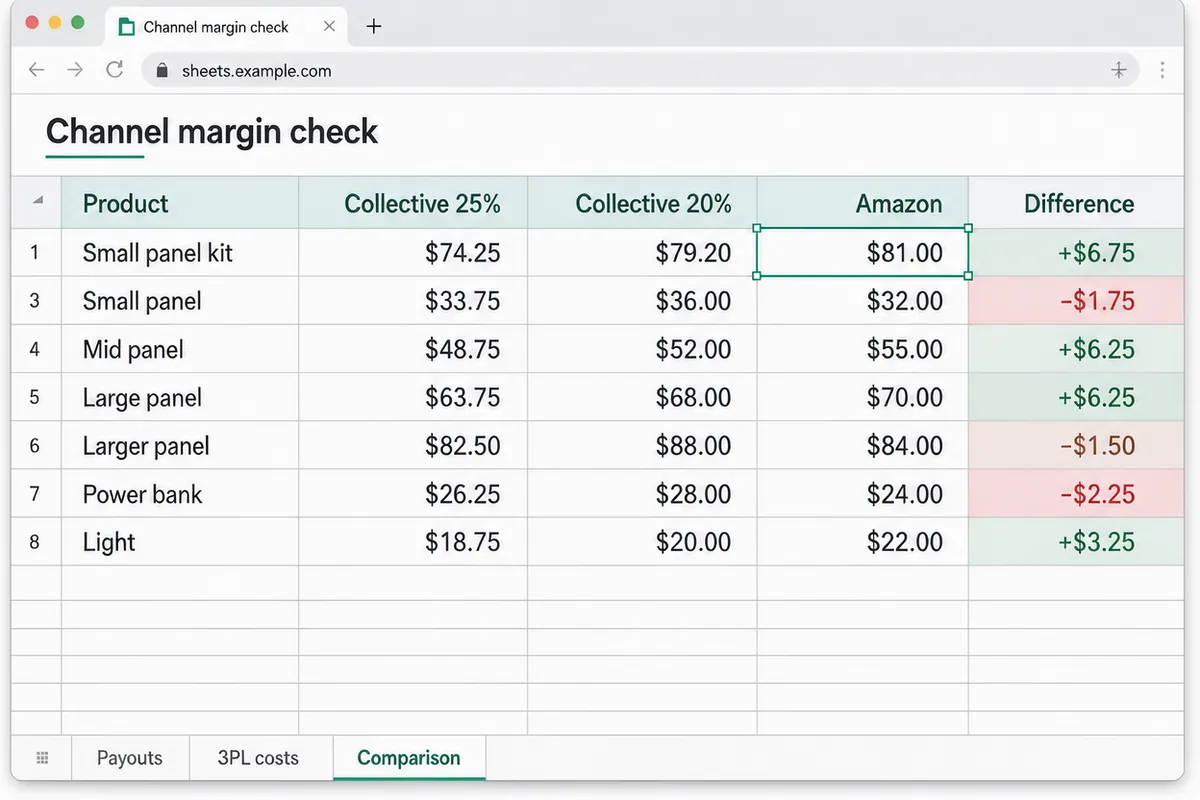
| Product | Collective at 25% | Collective at 20% | Amazon |
|---|---|---|---|
| Small panel kit | $16.36 | $20.36 | $16.32 |
| Small panel | $10.89 | $13.89 | $18.36 |
| Mid panel | $15.36 | $19.36 | $23.59 |
| Large panel | $30.28 | $36.78 | $35.33 |
| Larger panel | $41.84 | $50.59 | $50.01 |
| Largest panel | $42.46 | $54.96 | $67.20 |
| Power bank | -$2.79 | -$1.54 | -$2.81 |
| Light | $3.00 | $5.00 | $9.30 |
| Mini light | $2.02 | $3.52 | $9.11 |
At 25%, the kit roughly ties Amazon (four cents ahead) and nothing else gets close, apart from a power bank that loses money no matter where it sells. At 20% the kit, the large panel and the larger panel pull even or ahead. The small panel, the mid panel and both lights still trail by a lot.
One caveat. Our 3PL's per-order cost in that math is an estimate from the last reconciliation plus their recent increase, so the Collective columns are close, not exact.
Our take: let a table like this set your margin, not Shopify's 20% to 50% range. Amazon's costs hide in a dozen line items. Collective's cost is one big obvious one, shipping a single unit to a single person, and that hurts most on cheap, light products.
What we changed
Nobody got cut. Collective is incremental business for us with no ad spend behind it, and I'd rather not lose a good retailer over a couple of dollars.
Going forward, new retailers get panels at 20%, and the ones already selling stay at 25%. The power bank comes off as a standalone product since it loses money shipped alone on every channel we sell it on. The small lights are borderline too. They'll either come off or stay as add-ons to a panel order.
Before you accept your next Collective invite, build that table for your top ten products. It's an afternoon with your Amazon payout report and a 3PL invoice.
Protecting price and channel
What worries me with any wholesale-style channel is a retailer who undercuts you, or who starts bidding on your brand name in Google. So our invites spell it out. No inventory to buy and nothing up front, but please don't run paid Google ads on our products and don't list them on Amazon, Walmart, eBay or any other marketplace. The same agent that sends follow-ups also checks retailer listings for price cuts and ads on our brand terms.
Black Friday forced one more decision. Our sitewide discount doesn't flow through to Collective. The retailer pays our normal cost price regardless, and Shopify's help docs confirm that any discount code a retailer runs comes out of their margin, not your cost. Good for us. Still, tell your retailers ahead of time, or they'll find out when they see your own site at 20% off.
Collabs has its own version of this leak, with creator codes ending up on coupon sites; our Shopify Collabs guide walks through how we audit it. If your Amazon numbers are fuzzy, start with TACoS on Amazon, because ad spend is the biggest hidden line in this comparison.
Shiptronix is a technology advisory and services firm in Tampa, Florida. We set up channels like this, run retailer outreach and do margin reviews as part of our e-commerce management work.
Frequently asked questions
Is Shopify Collective free for suppliers?
There's no setup fee and no commission on Collective itself, as long as your store is eligible. You pay through the margin you give retailers and the cost of shipping each order yourself.
What margin should I give retailers on Shopify Collective?
Shopify's guidance is 20% to 50%, but start from your own per-unit profit after shipping and compare it with your other channels. For us, 20% put our kit, large panel and larger panel ahead of Amazon per unit. At 25%, only the kit kept up, and by four cents.
Who handles returns on Shopify Collective orders?
The retailer deals with the customer and refunds them. You handle the physical return and refund the retailer through Collective. Settle the label, the return window and condition rules before the first order ships.
Can a retailer pick which variants of my product to sell?
They can't. Every variant on a product imports together, so anything you want sold on its own needs to be a separate product.
Does my store discount apply to Collective orders?
It doesn't. Retailers pay your price-list cost whatever your own site is running, and any discount they offer comes out of their margin.